
What’s your Purpose?
What is your real Purpose?
Why does your business exist?
The immediate answer, for many companies, is very simple: to make money. And, of course, for a business to survive and thrive, it does need to make sufficient profit to reinvest in the business. But what if there’s more to it than that?
-
It seems to me that, if this is the only sense of purpose, it could lead to a business seeking to make money by any means and at any cost. In his book “Drive”, author Dan Pink suggests that where making money is disconnected from a more meaningful sense of purpose “bad stuff happens.” To take an extreme, look at organised crime groups. While they may not be there, many businesses today seem to pursue “delivering shareholder value” – surely a proxy for profit making – as their sole aim.
More practically, simply having a “making money” as a purpose is quite a fizzy goal. How does it help the business to determine what it does, or doesn’t do, who it does it for and so on.
Eli Godratt, author of “The Goal”, seeks to develop this while keeping “make money” and the top of the pile by completing the statement “make money by . . . . . . .”, then develops ideas like “increase profit”, “increase return on investment, increase cash flow” or, in more operational terms, increase throughput (generating money through sales), managing inventory (the money the system has invested in purchasing things it intends to sell) and reducing operational expense (the money the system spends to turn inventory into throughput). All of these are helpful, yet are still focussed on the money side and don’t help us know what to do or how to do it.
Maybe there’s another way of looking at it.
"Just as people cannot live without eating, so a business cannot live without profits. But most people don’t live to eat, and neither must businesses live just to make profits."
JOHN MACKEY, WHOLE FOODS
To go to an extreme, Hiroshi Tsukakoshi, founder of Ina Food in Japan and a highly respected business leader there, goes so far as to say “profit is excrement!” Not that he’s saying profit is a bad thing – indeed, his business is the most profitable in its sector. What he is saying is, just as excrement is the output of a healthy body, so profit is a result of a healthy company that is doing something more meaningful. In other words, having a purpose beyond profit.
"The brands that will thrive in the coming years are the ones that have a purpose beyond profit."
RICHARD BRANSON, VIRGIN
-
Such an organisation has a clear answer to the question “WHY do we exist?” (its Purpose) that goes beyond making a profit. It knows clearly WHO it seeks to serve and WHAT it does for them (its Mission). From that it derives a clear Vision (a sense of how the organisation intends to be) and a Strategy that defines HOW it will achieve the Mission. From there, it develops a series of long-, medium- and short-term goals that all move towards achieving the Vision. This process is cascaded down the organisation such that every function, department, team and individual is clear about their purpose. They understand how their role helps to achieve the overall mission of the organisation and have goals and measures that are aligned to those of the organisation. Such a combination, done well, can be highly motivating, keeps everyone focussed and delivers an organisation that is highly effective, profitable and sustainable.
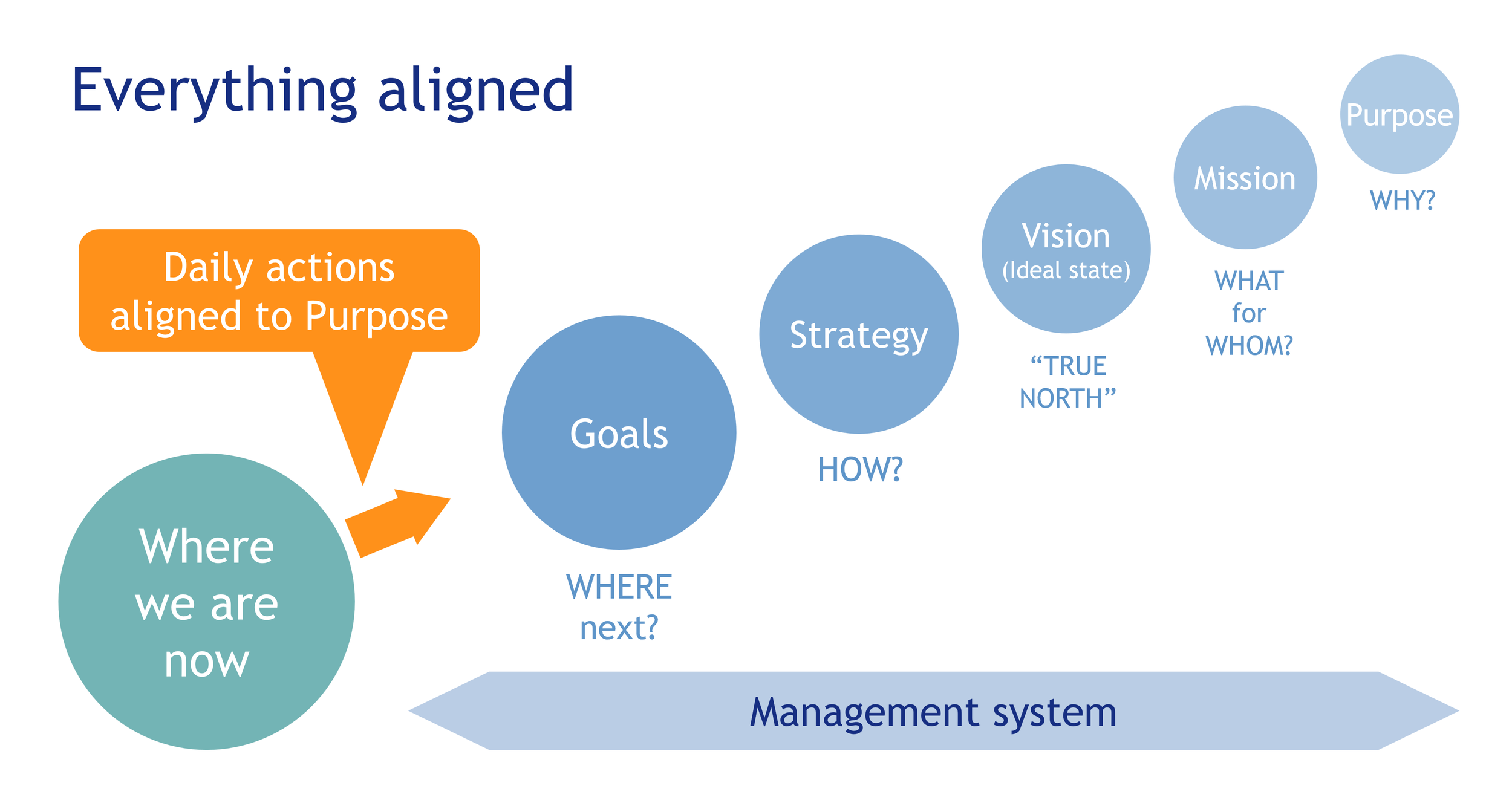
The details of this latter part are covered in subsequent sections. For now, let’s look at how we might derive Purpose and Mission.
Defining your Purpose and Mission
Purpose answers the question “WHY do we exist?” beyond making a profit. It is typically value driven, reflecting the core values of the organisation and the impact it seeks to make. Clarity of purpose keeps the organisation focused on delivering customer value, strengthens motivation by clarifying the reason behind the work, and connects individual actions to the bigger picture, building ownership, pride, and a deeper sense of contribution across all levels.
-
Stronger decision-making
A clear purpose acts like a compass. When leaders face tough choices, they can ask, “Does this align with our purpose?” This leads to faster, more consistent decisions.Employee motivation and engagement
People are more motivated when they feel their work matters. A clear purpose helps employees see how their roles contribute to something meaningful, increasing commitment, morale, and retention.Clear direction and focus
Purpose helps a business prioritize what to do—and what not to do. This reduces wasted effort and keeps teams aligned around common goals.Stronger brand identity
Customers are more likely to trust and support businesses that stand for something. A clear purpose differentiates the brand and builds emotional connections with customers.Improved customer loyalty
When customers understand and believe in a company’s purpose, they are more likely to stay loyal and recommend it to others.Better alignment across teams
Purpose unites departments and teams, reducing conflict and silo thinking. Everyone understands what the business is working toward.Long-term sustainability
Purpose-driven businesses tend to think long term rather than chasing short-term profits, helping them adapt, innovate, and remain resilient during change.Attracts talent and partners
Talented employees, investors, and partners increasingly choose organizations whose purpose aligns with their values.
In short: a clear purpose gives a business direction, inspires people, strengthens its brand, and supports long-term success.
Some questions to help to define Purpose
-
Beyond making money or delivering tasks, what difference are we here to make?
What problem do we exist to solve?
What value do we uniquely bring (distinctiveness)?
Who would genuinely miss us if we disappeared tomorrow—and why?
What need are we meeting that wouldn’t otherwise be met?
-
What should be different because we exist?
What long-term outcomes are we working toward?
How do people’s lives, work, or decisions improve because of us?
What would “success” look like in 1, 5 and 10 years if we stayed true to our purpose?scription text goes here
-
What kinds of work clearly fit—or don’t fit—our purpose?
What trade-offs are we willing (or unwilling) to make?
When resources are tight, how does purpose help us prioritise?
What lines won’t we cross, even if it’s profitable or popular?
-
What behaviours should people consistently experience from us?
How do we want to be described by those we work with?
What values are non-negotiable in how we operate?
What behaviours would clearly undermine our purpose?
-
Where do we already see this purpose in action today?
Where are we currently misaligned with it?
What would need to change for this purpose to be real, not aspirational?
How would a new team member see this purpose in their first 90 days?
A good test of the above is to ask “Can this purpose help someone make a hard decision when priorities conflict?” If not, it’s probably too vague.
What’s your Mission?
Many Mission Statements can be very bland and provide little clarity to anyone. They may appear worthy but are actually generic and meaningless. A great definition of Mission defines how your Purpose works out in practice. It answers the question WHAT do we do and for WHOM? It defines the value that the organisation uniquely brings and provides real clarity. It links aspiration to execution. It guides decisions, energises teams and keeps work focussed and meaningful.
Some questions to help to define Mission
-
What do we do better or differently than others?
What would we never want to outsource because it’s core to who we are?
What strengths, capabilities, or perspectives make us uniquely effective?
If another team did our job, what would feel off?
-
Who are our primary beneficiaries
(customers, users, communities, internal teams)?Who do we serve first when trade-offs arise?
Whose outcomes matter most when we define success?
Who do we need to collaborate with to fulfil our purpose?
Once your Purpose and Mission are clear, you’re ready to move on to defining a framework for putting it into practice.
Ready for action?
I’ve facilitated this process for many organisations and teams over the years and would be delighted to support your organisation with anything from answering a simple question to facilitating the full process for you.
To book a free, no obligation call, just click the button below. No pressure, no sales pitch, just an open conversation and, hopefully, some helpful input. Alternatively, complete our contact form and we’ll get back to you.
Is lack of clear Purpose damaging relationships in your business?
The look of surprise on the client’s face said it all. I’d just fed back that, after a round of interviews with senior leaders in the organisation, there was no consistent view of the purpose of his problematic department.
Yet, to me, the evidence was clear to see. Other areas not accepting their involvement, mistrust and lack of respect, arguments about what needed to be delivered and when. All resulting in projects being delivered late, over budget and not delivering the performance needed. To others, this department was just getting in the way of them doing their job.
“I don’t understand it,” he said. “If you go to their intranet page, it’s really clear what they do.” And yes, it was clear. What was missing was the WHY they were doing it. What was their activity contributing to the overall purpose of the organisation that the other teams were missing? This also suggested that not only did the problematic department lack clarity of purpose, but the WHY for other areas was was not 100% clear either.
“When you’re surrounded by people who share a passionate commitment to a common purpose, anything is possible”
HOWARD SHULTZ, STARBUCKS
It was a classic case of siloed thinking. Each department focussed on what it saw as important, yet a misalignment of objectives between departments leading to the inevitable tension, disagreement and downward spiral in relationships.
The way forward is at one level very simple, yet at another difficult to do. Get the groups to work together to develop a shared purpose that recognises the importance of everyone’s contribution to achieving the organisation’s overall purpose, using this as a catalyst for improved working relationships.
Over the years I’ve seen so many “aha” moments as different teams suddenly see each other in a new light. Almost immediately the dialogue changes. “How can we find better ways to work together?” “What does the overall process look like?” And so the upward spiral begins towards a healthier, more collaborative way of working.