

Goal Setting and Delivery
Setting and working on goals is a common practice in many organisations. However, following through on the plans to act on them and deliver real benefits to teams and organisations is perhaps less common.
Below we explore a number or common reason why this can happen. Then over the following pages, we’ll take you through a sequence of:
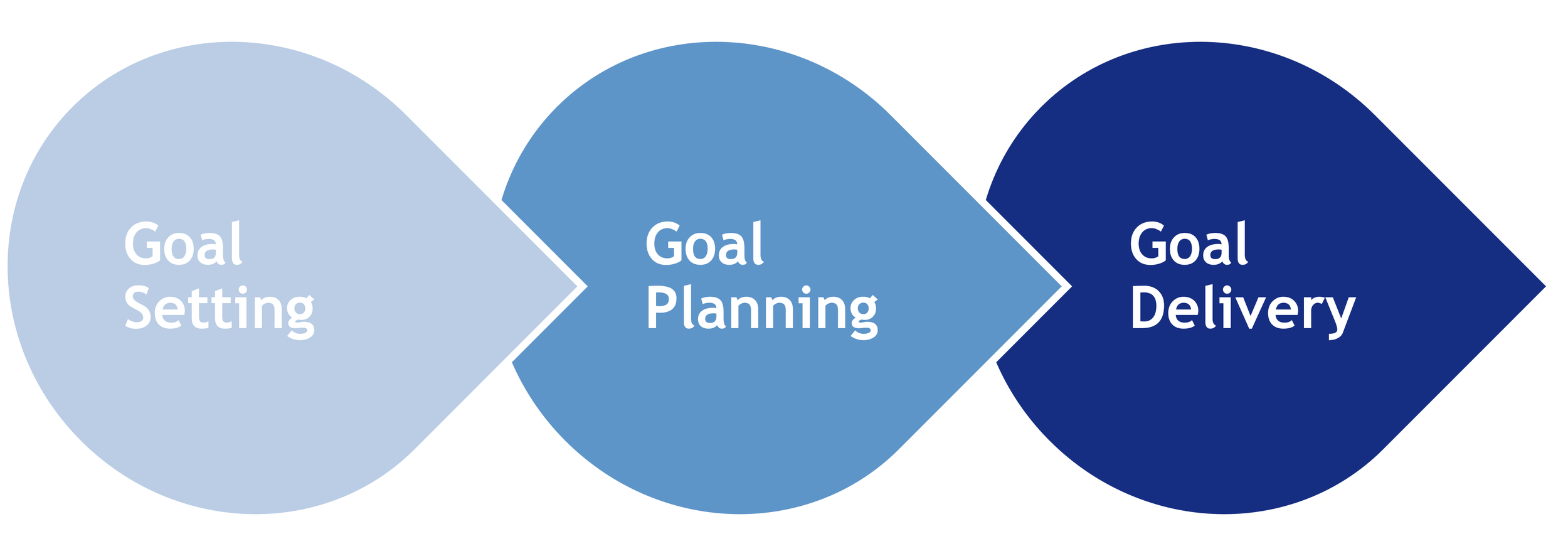
Goal Setting: Setting goals that are aligned to your organisational Purpose and Vision
Goal Planning: Developing a robust plan to work towards your goals
Goal Delivery: A powerful method of ensuring that your plans are delivered
Study of highly successful organisations, plus our own experience with clients over many years, has demonstrated the power of this process and its ability to deliver year–on–year performance improvement.
The challenge of goal setting and delivery
If you’re like many organisations, you’ll typically set ambitious goals each year, whether for growth, performance improvement or something else. So here’s a challenge. Take a minute and reflect honestly. Now think about what happened last year. Were some goals missed, amended or replaced? Why did that happen, and will anything really be different this year?
Now for the crunch. What score would you give out of 10 for your confidence that this year’s goals will be achieved?
Here’s the sobering fact. If you’ve scored 7 or less, a part of your brain has already admitted defeat and has started compiling a list of excuses!
You're not alone. Here are some mistakes I’ve noticed that organisations make in creating their goal plan at the start of a new year.
Common mistakes
Dive straight into this year’s goals without reflecting on last year’s. There’s almost an attitude of “last year is history, let’s reset”.
Set too many goals. With too many goals, there’s pressure to work on them all and rarely the time to do so, so there’s little progress on any.
Relevance of goals unclear / not seen as important. Teams come up with goals because they’re asked to, or because they seem like things they ‘should do’, rather than having a clear view of why the goal matters.
Set good goals but there’s no robust plan to achieve them. Maybe there’s a good intent or a rough plan, but is it thorough enough to give confidence that the plan will be achieved?
Create plans then put them in a drawer until questioned. There’s no regular mechanism to review progress and keep things on track.
Don’t set aside time to work on goals. Somehow there’s an assumption that this work will be fitted in somehow, rather than making it part of the routine and having dedicated time blocks for working on and reviewing plans.
Don’t recognise that conditions (Internal or external) have changed. As part of each review, don’t consider what has changed that may cause the plan, or even the goal, to be changed.
There is a better way
So, if you want it to be different this year, here are some things I’ve identified over the years, both in my own practice and through working with clients, that will give you clues on what’s needed to make it a ‘10’.
Take time to reflect on the previous year. There’s a treasure there. Identify and celebrate what has been achieved – great for morale. Even more, what has been learned about the organisation, its people and how it works on its goals. What clues does that give us to both the goals we set and the process we use?
Identify the ‘critical few’ goals. What improvements will make a real difference this year? Can you be really tough and have just one goal per team/individual (recognising that they will also need to contribute to others’ goals too)?
Align goals across the organisation. Both up and down and side–to–side, how do each team’s goals link to the organisation’s strategy and goals? How well do they fit together?
Have a robust plan. Clear actions and timing to show what needs to be done, recognising uncertainties and risks. Most goals will require new things to be done, so experimentation and failure will be part of the journey. Expect it and allow for it. Have good measures of progress and achievement so you know how you’re doing.
Have a good process for delivery: Build in regular reviews involving others for support and accountability. Adopt a PDCA (Plan–Do–Check–Adjust) approach. What has been achieved and learned in the last period, and how does that require us to adjust the plan going forward. It’s all about learning to make progress rather than blame.
The Benefits
With this more structured approach – part of our "high performance with ease" model – you will ensure your organisation has greater confidence in both setting and delivering on goals that will make a real difference. The beauty of this method is that it involves everyone from the outset and ensures they begin the year with a crystal clear picture of what good will look like. You have great people; now give them a great system!
The key positive outcomes this creates are:
Your success this year is based on learning the right lessons from the last. So you don't repeat mistakes and you keep all the gains you made. Plus your whole team knows what they're capable of achieving as well as how to do so.
The goals you set really will be goals, not just tasks - challenges your teams want to work on, bringing improvements that strengthen the business and delight your customers.
Everyone is clear what really matters and having cross organisation alignment reduces waste and improves return on investment.
The PDCA delivery approach means you learn as you make progress. It can also create space for experimentation so entirely new things can be done successfully.
On the following pages, we’ll take you though the processes of:
Ready for action?
Get in Touch
If you’d like to learn more about how you can build a powerful vision or set, plan and deliver powerful goals, please book a free, no obligation call using the button below - no sales chat, just a conversation to understand your situation, answer your questions and explore if we can help. Alternatively, complete our contact form and we’ll get back to you.
Vision and Goal Setting “Workshop in a (Virtual) Box”
Based on the process we use with clients, we have created a “Workshop in a (virtual) box” with all that you’ll need to run a powerful workshop with your teams to create a robust vision, set goals to achieve them and ensure that those plans are executed in an effective way.
In it you’ll get:
Workshop Overview with all the thinking behind each session
Leader’s Guide to equip you to set you team up for success
Facilitator Guide with detailed background and step–by–step instructions on how to run each session
A full set of Workshop Slides
Worksheets for each stage
To make sure that you get the most from your workshop, we also including a bonus pre– and post–workshop Q&A call with Harvey Leach to answer any questions you may have about running the workshop and putting your plans together.
Grab your “Workshop-in-a-(virtual) Box” here for just £195 and look forward to a really productive year with your team.
