

Goal Setting
Setting goals that are aligned to your organisational Purpose and Vision
Setting great goals
Most organisations have some form of annual goal setting process, whether for the organisation as a whole, for functions, departments, teams or individuals. Often these goals are only loosely connected, reflecting local priorities or even simply ‘good ideas’ in that area.
The goal setting process can be much more powerful if each department’s and team’s goals are aligned to the overall Purpose and Vision for the organisation.
Purpose defines why the organisation exists, answering questions such as who it is there to serve and what with. Vision sets long-term direction. Well set, it provides a rich description of what the organisation is becoming. It provides a “true north” to guide all other goal setting and action planning activities.
However, the vision itself is rarely detailed enough to allow specific actions to be defined. By its very nature it is long-term and directional rather than precise and detailed. Some shorter-term goals are required. The vision provides the “why” that gives goals context and meaning.
The goals themselves help departments and teams answer the question, “how does what we do contribute to the overall goals of the organisation?” This can be incredibly powerful and motivating, especially if teams are able to contribute to the development of the goals and the overall goals are seen to incorporate aspects that the teams see as important.
Aligning Goals to Vision
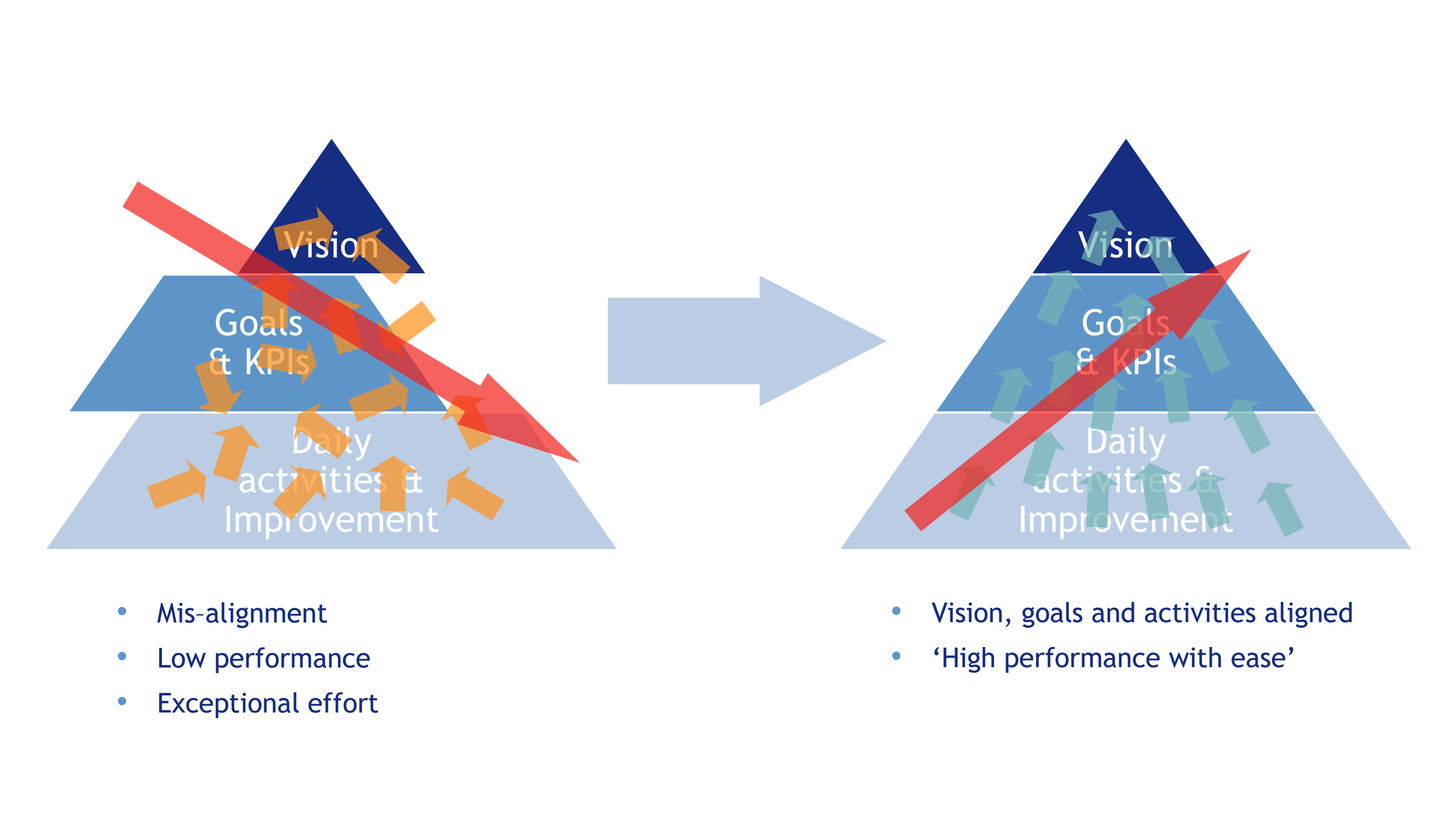
By asking the check question – “does this goal or action move us in the direction of our vision?” – we take the first step towards aligning everything we do to its achievement.
The overall aim is steady progress in a consistent direction, with mid-term and annual goals building progressively towards achievement of the vision.
At an organisational level, these should be the “big moves” – often referred to as “breakthrough goals” - that will start to close the gap between where the organisation is now and what it will be like once the vision is achieved.
Typically, these will be mid-term goals in a relatively small number of areas – say no more than-6 - with a time horizon of 3-5 years. Focus on too many areas is likely to lead to lack of clarity and dilution of effort. Better to make good progress in a few areas then tackle others than to struggle in many.
These goals should be ambitious and challenging, requiring a “step change” in performance. While we may over-estimate what can be achieved in a short timescale, we are more likely to underestimate what can be achieved in a longer time, so don’t be afraid of a significant ‘stretch’ here.
It may even be just one area. The story of Paul O’Neill’s transformation of Alcoa by having a single focus on worker safety is legendary. (If you don’t know it, just search on ‘Alcoa, safety, O’Neill’ and read or watch). This single focus created breakthrough changes in performance and culture that led to many other improvements too.
The key is to pick areas that will affect and involve all or most of the organisation and also drive changes in other aspects as well.
Once the 3-5 year goals are defined, the next step is to set targets for the year ahead that specify the next step in achieving them. While still challenging, these should be set more conservatively. It’s important that these goals are seen as realistic and achievable by the majority of those involved.
Setting goals at every level
So far, we have only set goals and targets at the organisation level – a necessary step but not of itself sufficient. It is likely that achievement of these goals will require action in many parts of the organisation, so the next step is to translate the high level goals into local goals for each function, department and team, maybe even individuals in the team.
The challenges here are twofold:
1. Making the corporate goals relevant to the function, department or team
A key question to ask here is “how does what we do impact or contribute to the overall goal?” Answering this for each area involved will break the high level goals down into relevant, manageable chunks.
2. Ensuring that all the local goals “join up” and don’t create tension or conflict
Careless setting of local goals and measures can lead towards local optimisation that can actually have a negative effect on overall performance. For example, an excessive focus on efficient utilisation of transport can lead to shipping delays due to waiting for a full load.
In both cases, looking at the organisation as a system of inter-related parts can help here, considering how product or information flows from one area to the next. Outputs from one area will be inputs or enablers to another, and hence the linkages can be clearly established.
As an aside, this “system” approach is as useful for daily routine work as it is for breakthrough goals. Considering inputs and outputs will help to establish the right KPIs at every level.
Top Down and Bottom Up
In many organisations, goal setting is very much a “top down” process, with goals cascading from the executive down through department heads to team leaders and team members.
However, the process can be much more powerful when a “bottom up” approach is included. This ensures that ideas and concerns from every level in the organisation are considered before coming up with the final goals and plans in much the same way as we talked about in the previous article on vision.
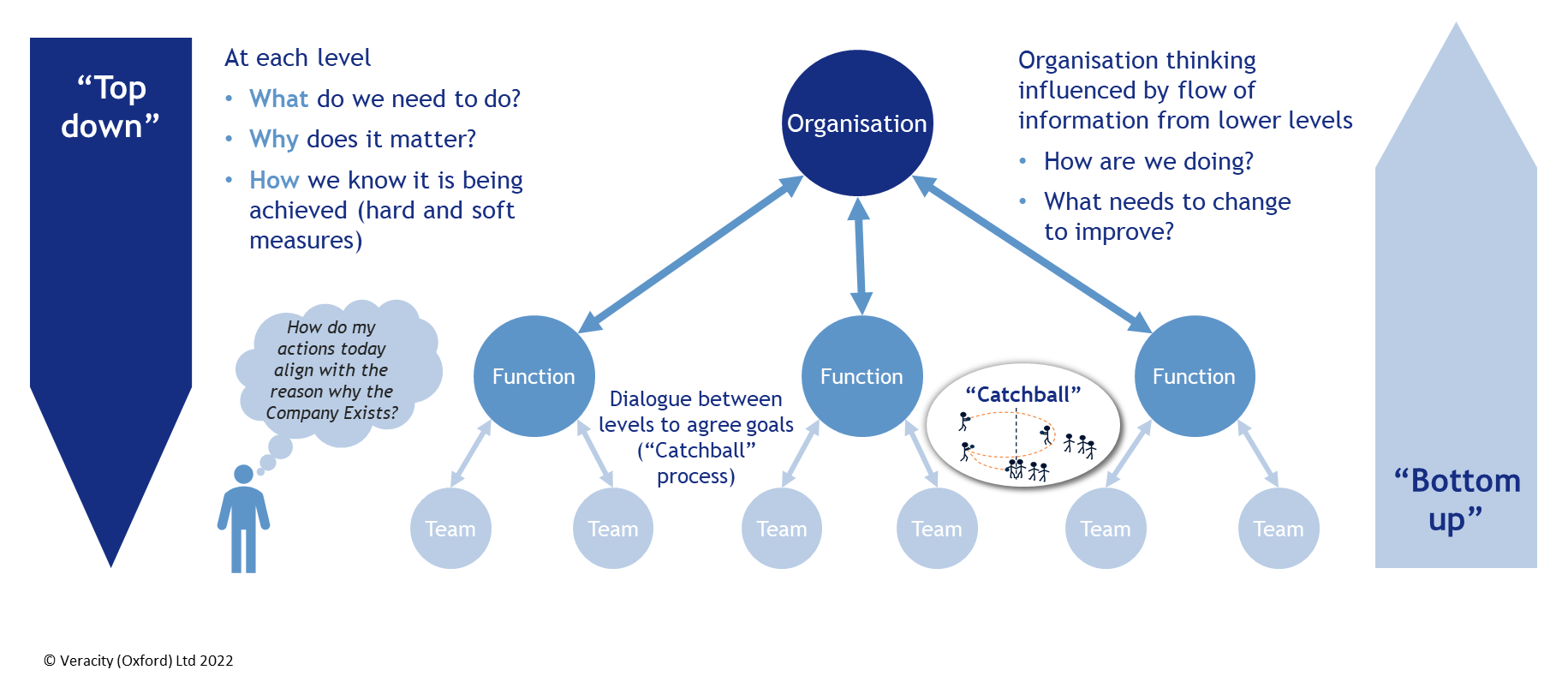
Catchball
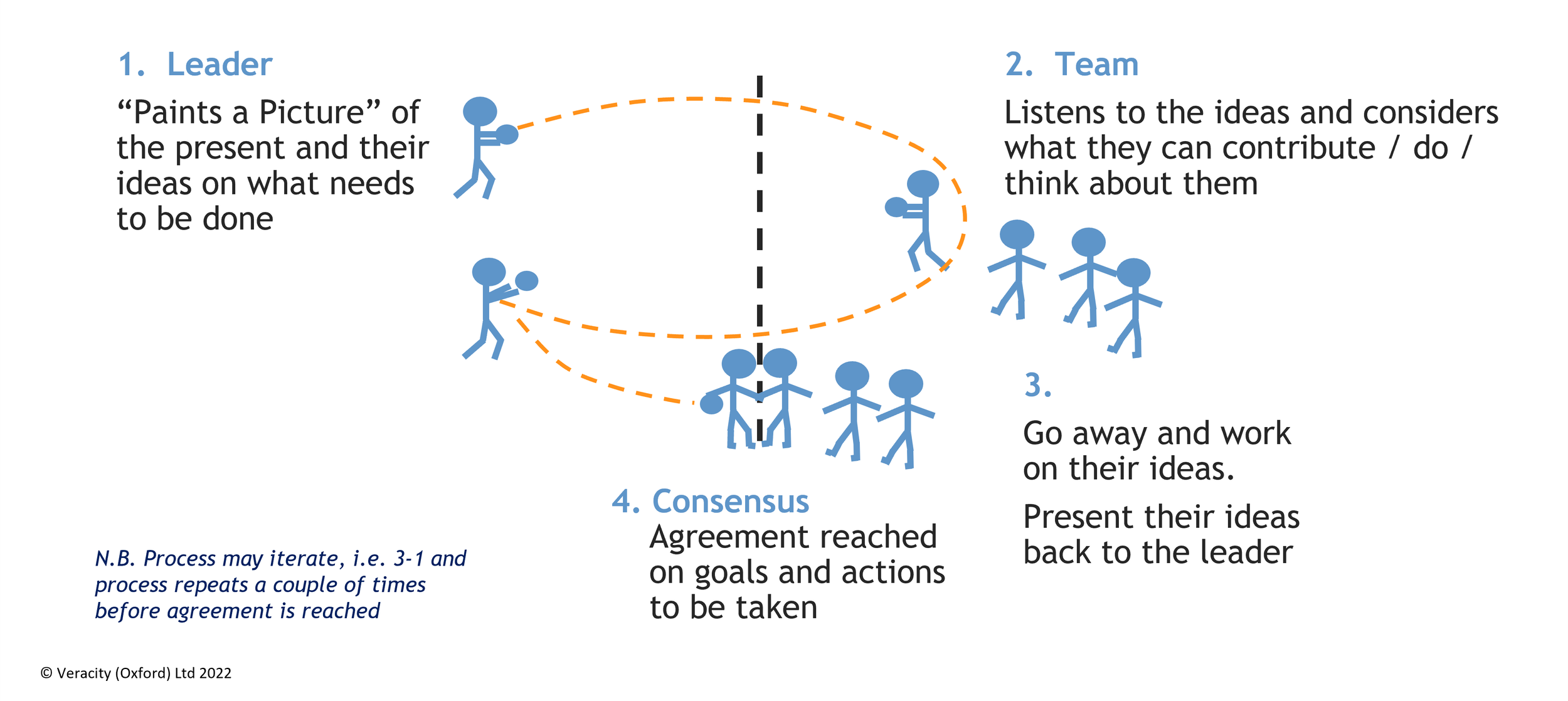
A great method for this is the “catchball technique”, used for reviewing the goals and plans with others and modifying them based on feedback. There are four steps to this process.
The leader “throws the ball” by describing their ideas for the goals and plans to achieve them.
The leader asks the team for their reactions and inputs. Great questions to ask might be:
Are we focussing on the right things?
What concerns do you have?
What might be missing?
What additional ideas do you have?
The team goes away to reflect and discuss, then feed back to the leader. The leader reflects and then works with the team to modify the goals and plans based on the feedback.
The process iterates until there is consensus.
In a larger organisation, this process will involve several levels and take some time. However, it will dramatically improve the quality and robustness of the plans at every level of the organisation. This in turn will actually speed up progress towards the goals.
Another significant benefit of this approach is that the goals of the organisation and the personal objectives of the individuals in it are aligned. The questions posed during the ‘catchball’ process will almost certainly reveal those things that really matter to the individuals involved as well as to the organisation.
Identifying these explicitly within the detail of the goals will make them truly meaningful, and hence motivational. This makes them far more likely to engage the “discretionary effort” of team members as they start to work on the goals. This is a huge positive for the overall health and sustainable success of the organisation and those in it.
Engaged, aligned and committed
The end result of this process, done thoroughly, is a well-defined structure of inter-related goals for the year ahead that will move the organisation significantly towards the achievement of its long-term vision.
Not only that, but the involvement of everyone affected by the changes required to achieve those goals will have massively increased their commitment and provided greater clarity and detail on what is required.
Go as far as you can see!

“Don’t worry about what lies ahead. Just go as far as you can see.
When you get there, you’ll be able to see further!”
The process described above is intentionally focussed on the relatively short-term, in this case, one year goals. This is akin to identifying the top of the first hill in the picture above, with the 3-5 year goals being the subsequent hills and the Vision represented by the distant mountain.
A common mistake is to try to plan in detail every step of the route to achieve the vision. However, in reality, the challenges to be overcome in the mid to long term are hard to establish. Even over the course of the year, let alone 3-5 years or longer, there will be changes to the circumstances within the organisation and in the external environment that will require changes to the goals.
More than that, the learning from working on the one-year goals will give greater insight into what is required in subsequent years to move towards achievement of the Vision.
This is Plan-Do-Check-Adjust on a larger scale, an annual cycle of improvement that moves the organisation steadily towards becoming the best version of itself.
We’ll come back to this latter point later. Next, though, we need to consider how to create and carry out a plan to achieve the goals.
Next>> Goal Planning: Developing a robust plan to work towards your goals
Ready for action?
Get in Touch
If you’d like to learn more about how you can build a powerful vision or set, plan and deliver powerful goals, please book a free, no obligation call using the button below - no sales chat, just a conversation to understand your situation, answer your questions and explore if we can help. Alternatively, complete our contact form and we’ll get back to you.
Vision and Goal Setting Workshop
Based on the process we use with clients, we have created a “Workshop in a (virtual) box” with all that you’ll need to run a powerful workshop with your teams to create a robust vision, set goals to achieve them and ensure that those plans are executed in an effective way.
In it you’ll get:
Workshop Overview with all the thinking behind each session
Leader’s Guide to equip you to set you team up for success
Facilitator Guide with detailed background and step–by–step instructions on how to run each session
A full set of Workshop Slides
Worksheets for each stage
To make sure that you get the most from your workshop, we also including a bonus pre– and post–workshop Q&A call with Harvey Leach to answer any questions you may have about running the workshop and putting your plans together.
Grab your “Workshop-in-a-(virtual) Box” here for just £195 and look forward to a really productive year with your team.
